Agenda:
- Introductions
- Motivation for course
- Formalisms used throughout the course
- Navigating the course
What is an algorithm?
an explicit, precise, unambiguous, mechanically-executable sequence of elementary instructions, usually intended to accomplish a specific purpose.
Examples?
BOB(n):
- for i n down to 1
- Sing “i bottles of beer on the wall, $i$ bottles of beer,”
- Sing “Take one down, pass it around, $i-1$ bottles of beer on the wall.”
- Sing “No bottles of beer on the wall, no bottles of beer,”
- Sing “Go to the store, buy some more, n bottles of beer on the wall.”
Lagniappe: Another old algorithmic drinking song is The Barley Mow. I'll leave it to you to come up with the program to produce it.
Examples of algorithm-like things that are not algorithms?
BeAMillionaireAndNeverPayTaxes():
- Get a million dollars.
- If the tax man comes to your door and says, “You have never paid taxes!”
- Say “I forgot.”
What makes a good algorithm?
- correct
- user-friendly
- many features
- robust
- simple
- secure
- low programmer cost
- efficient
- runs quickly
- requires little memory
Then, why study efficiency?
- separates feasible from infeasible
- correlates with user-friendliness
What if it took Google took 2 minutes to return results?
Simple warmup: What does this do?
def my_function(a, b):
    for i,v in enumerate(a):
        if v == b:
            return i
    return -1
def linear_search(mylist, key):
    """
    Args:
      mylist...a list
      key......a search key
    Returns:
      index of key in mylist; -1 if not present
    """
    for i,v in enumerate(mylist):
        if v == key:
            return i
    return -1

linear_search([5,1,10,7,12,4,2], 12)
4
What factors affect the running time of this algorithm?
- Input size
- Input values: is key at start or end?
- Hardware!
- TI-85 vs. Supercomputer
We need a way to compare the efficiency of algorithms that abstracts away details of hardware and input.
Analysis of Linear Search, the long way
- Assign a time cost $c_i$ to each line $i$.
- Figure out how often each line is run $n_i$
- total cost is the cost of each line multiplied by the number of times it is run
$ \hbox{Cost(linear-search, mylist, key)} = \sum_i c_i * n_i $
def linear_search(mylist, key):        #   cost         number of times run
    for i,v in enumerate(mylist):      #   c1               ?
        if v == key:                   #   c2               ?
            return i                   #   c3               ?
    return -1                          #   c4               ?
Best/Average/Worst case
To deal with the effects of the input values on performance, we can consider three types of analysis:
- Worst-case: maximum time for any input of size $n$
linear_search([5,1,10,7,12,4,2], 9999)
- Best case: minimum time of any input of size $n$
linear_search([5,1,10,7,12,4,2], 5)
- Average case: expected time over all inputs of size n
- Need some probability distribution over inputs
for (mylist, key) in ???:
    linear_search(mylist, key)
Worst-case analysis of linear search
Assume $n \leftarrow$ len(mylist)
def linear_search(mylist, key):        #   cost         number of times run
    for i,v in enumerate(mylist):      #   c1               n
        if v == key:                   #   c2               n
            return i                   #   c3               0
    return -1                          #   c4               1
$ \hbox{Cost(linear-search, } n) = c_1n + c_2n + c_4$
Cost is now just a function of:
- input size $n$
- constants $c$ (depend on machine, compiler, etc)
How granular should we get?
Consider this slightly different implementation:
def new_linear_search(mylist, key):    #   cost         number of times run
    for i in range(len(mylist)):       #   c5               n
        if mylist[i] == key:           #   c6               n
            return i                   #   c3               0
    return -1                          #   c4               1
$ \begin{align} \hbox{Cost(new-linear-search, } n) = c_5n + c_6n + c_4\\ \hbox{Cost(linear-search, } n) = c_1n + c_2n + c_4 \end{align} $
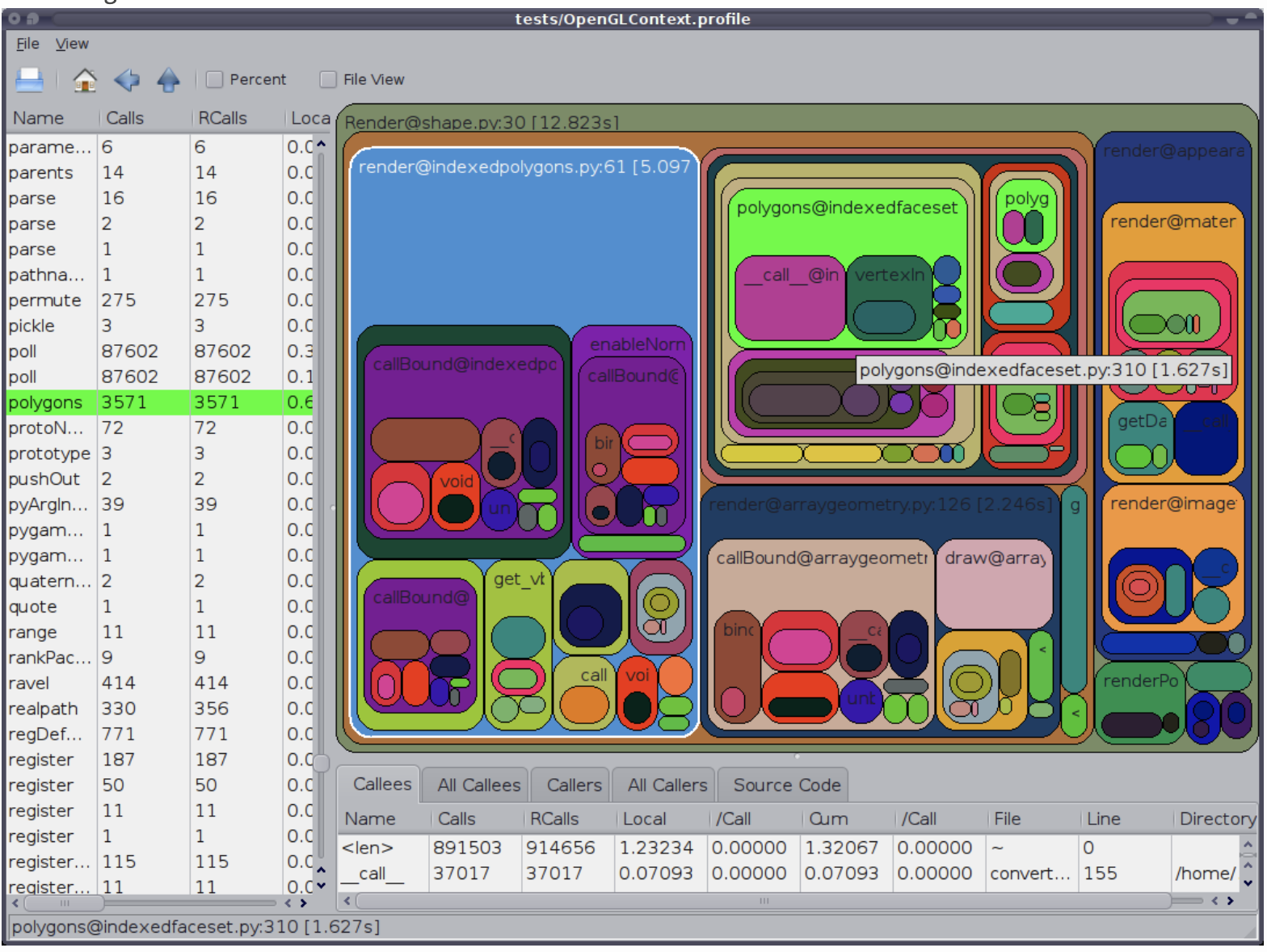
There is a line between analyzing algorithms and optimizing a specific implementation (e.g., through profiling):
Big Idea
- Ignore machine-dependent constants
- Focus on growth of running time
- What happens in the limit as $n \rightarrow \infty$
$ c_1n + c_2n + c_4 \approx c_5n + c_6n + c_4 $
Course Overview
- Analyzing algorithms: methods to compute tight bounds on running time
- Designing algorithms: various approaches to designing efficient algorithms
- lists, sequences, trees, graphs,...
- Distinct from typical courses like this, we will emphasize parallel algorithms from the start
Navigating the course
- Canvas: syllabus, dates, grades
- Diderot: online textbook
- Github: assignments, slides
Next time
Mathematically define our Asymptotic Notations and introduce tools for performing asymptotic proofs.